Brand Partnerships
September 3, 2026
What Brands Should Consider When Partnering with Creators
Explore the content creator versus influencer difference and learn what brands should consider when choosing creator partners.

Explore the content creator versus influencer difference and learn what brands should consider when choosing creator partners.
Content creator. Influencer. Two titles often used interchangeably – and, honestly, the line between them can get blurry. But when there’s budget on the table, the distinction matters.
A brand hiring someone to create six TikToks for paid social is buying something very different from a brand paying to reach an established community of 500,000 followers. One is primarily investing in content. The other is investing in content, distribution and influence.
Plenty of social-first talent can deliver both. The trick is knowing what your campaign needs before you start scrolling through profiles.
This guide breaks down the content creator vs influencer difference, what each brings to a campaign and how to choose a partner who suits your audience, goals and budget.
The simplest way to separate the two is to look at their main role in the campaign.
That does not mean content creators have no following or influencers lack creative skill. Most influencers create content too, and many creators have engaged audiences of their own. These are not rigid job descriptions. They are a useful way to understand where the value in a partnership comes from.
What is a content creator?
A content creator produces digital assets designed for online platforms. That could include TikToks, Reels, product demos, reviews, tutorials, photography or YouTube videos.
They are typically chosen for their ideas, production skills and understanding of what feels native to a platform. They may create for their own channels, but they can also be commissioned to produce assets for the brand’s social accounts, website or advertising.
A huge following is not essential. If the goal is to build a bank of strong, reusable content, creative ability matters more than audience size.
What is an influencer?
An influencer has built attention, credibility and trust with a particular audience.
Brands are not only paying them to produce content. They are paying for access to the community around it: people who follow their recommendations, understand their references and care what they have to say.
That relationship can help a brand reach a relevant audience, build familiarity or encourage action. The value is not just that the post gets seen. It is that the recommendation comes from someone the audience already knows.
Content Creator vs Influencer at a Glance
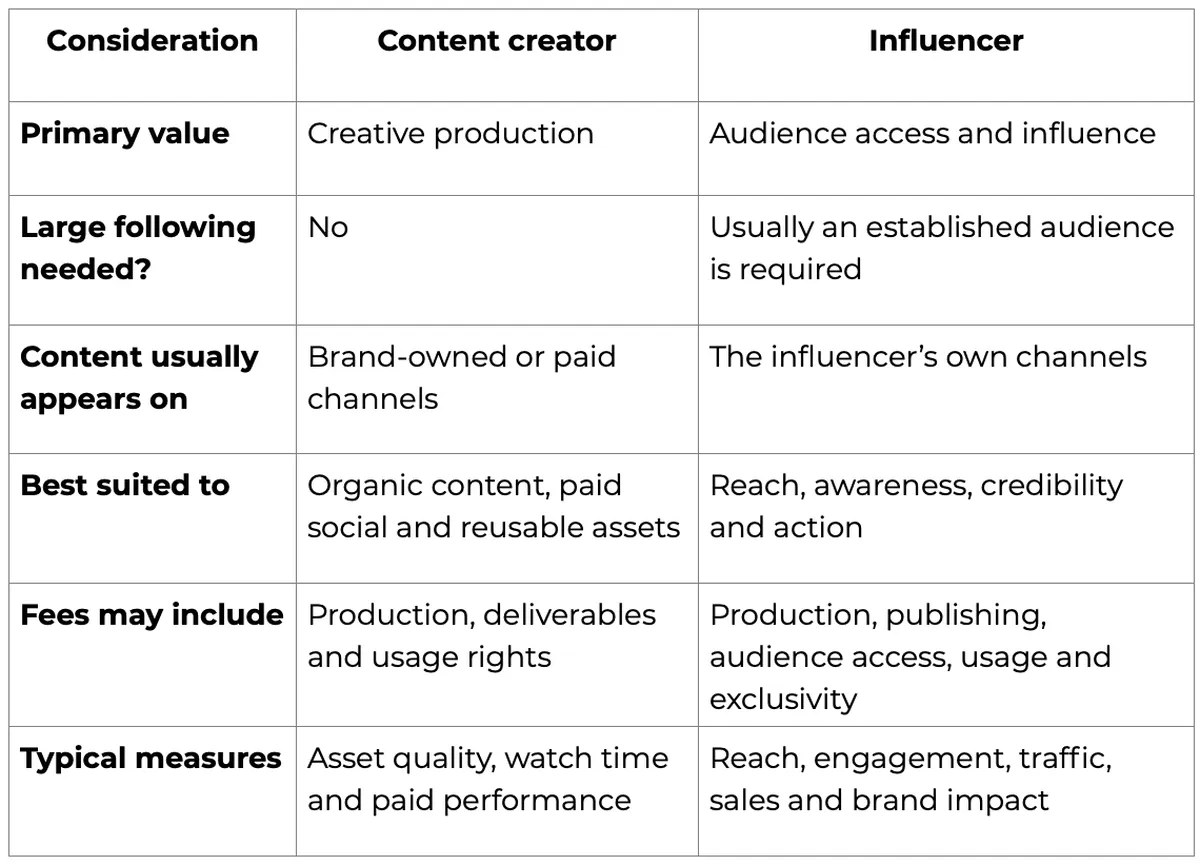
Before building a shortlist, decide what the partnership needs to achieve. Do you primarily need content, audience access or both?
If the brand needs social-first assets for its own channels, a content creator may be the strongest fit. If the goal is to reach a new audience, build credibility or generate conversation, an influencer with the right community may offer more value.
For larger launches, the best partner might sit somewhere in the middle: creatively strong, trusted by their audience and able to produce content that works organically and through paid media.
A large audience is only valuable when it contains the people your brand needs to reach.
Follower count can indicate potential reach, but it says very little about relevance, trust or buying behaviour. Review audience location, age and interests alongside engagement quality, comment sentiment and the creator’s previous commercial partnerships.
A smaller creator with a highly relevant community may offer far more value than a bigger name whose followers have little connection to the product.
Look at the relationship too. Does the audience ask questions, share experiences and respond to recommendations? Or are the comments generic and disconnected from the content?
Reach tells you how many people saw the campaign. Audience relevance helps indicate whether they were the right people.
Do not appoint someone based on one viral post and a pleasing grid. Review a broader sample of their work. Can they hook attention, explain a product clearly and integrate commercial messages without turning the content into an advert? Do their sponsored posts feel as engaging as their organic ones?
Visual polish is not the only marker of quality. A lo-fi demonstration, honest review or creator-led tutorial may outperform something that looks like a traditional campaign shoot.
Platform fit matters too. TikTok content should feel like TikTok content, not a television ad squeezed into a vertical frame.
Great creator work does not simply look good. It understands the audience, the platform and the job it has been hired to do.
Will the content be published on the talent’s channels, the brand’s channels or both?
If it will only appear on brand-owned platforms, there may be little reason to pay a premium for a huge following. In that case, you need someone who can create the right assets – not necessarily someone with the biggest audience.
If the campaign relies on personal recommendation and organic reach, audience access becomes central. That is where influencer value comes in.
Paid use should also be considered early. A brand might want to amplify the content through its own advertising account or run creator-authorised ads from the influencer’s profile.
The publishing plan affects who you hire, what you pay and which permissions need to be included in the agreement.
Clarify content usage rights
Paying someone to create content does not automatically give the brand permission to use it everywhere, forever.
Agree which channels the content can appear on, how long it can be used and whether the brand can edit it. Paid advertising, website use, email marketing, product pages and international campaigns may all require additional rights.
The agreement should also confirm whether raw footage is included and whether ads can be run through the creator’s account.
Broader usage often increases the fee because the content is delivering more commercial value to the brand. That is not the creator being difficult. It is the creator understanding what their work is worth.
A useful brief gives the creator enough information to deliver what the brand needs without scripting away everything that makes them worth hiring.
It should cover the campaign objective, target audience, key message, deliverables, timings, mandatory information, claims to avoid, approval stages and call to action.
Then leave room for the creator to create.
They understand how their audience communicates, what holds attention and which formats feel natural. Over-control the execution and you risk ending up with content that is technically correct but painfully easy to scroll past.
The sweet spot is clear on the non-negotiables and collaborative on the creative. Brand strategy brings the direction. Creator instinct makes people watch.
A creator becomes a visible extension of the brand, so the partnership needs to make sense beyond audience numbers.
Review previous content, public positioning, commercial relationships and audience sentiment. Consider whether their humour, opinions and communication style fit the brand’s values and risk tolerance.
This does not mean choosing someone with no personality. Social media has enough content that sounds as though it was approved by twelve nervous committees.
It means understanding who the creator is publicly and deciding whether the connection will feel credible. The right fit should make immediate sense to the audience rather than looking like the product wandered into the wrong group chat.
Exclusivity can prevent a creator from promoting a direct competitor immediately before or after your campaign. But the terms need to be specific and proportionate.
Define what counts as a competitor, which products or categories are included, which platforms are covered and how long the restriction will last.
A broad exclusivity clause can limit the creator’s earning potential, so tighter restrictions will often increase the fee.
Protect the commercial value of the campaign without claiming an entire industry for six months after one Instagram Story. The restriction should reflect the scale, duration and importance of the partnership.
Not every creator collaboration needs to become a long-term love story. The right model depends on the objective, budget and amount of familiarity the audience needs to see.
One-off activation
A one-off activation can support a specific launch, test a new creator relationship or respond to a timely opportunity.
It works best when the connection between the creator and brand makes sense immediately. With limited time to build familiarity, the concept and brief need to be sharp.
Campaign-based partnership
A campaign partnership gives the creator more room to build a story across several deliverables or formats.
It suits seasonal activity, product launches and coordinated organic and paid campaigns. Repeated exposure can also help the audience understand the product without forcing every message into one overloaded post.
Long-term ambassadorship
Long-term partnerships can build familiarity, credibility and a more natural connection between the creator and product.
The creator gets to know the brand, the content improves over time and the audience sees genuine repeated use rather than a single appearance followed by radio silence.
For brands focused on community and sustained growth, this is often where creator relationships become most powerful.
Measurement should match the reason the creator was hired. For content-production partnerships, look at asset quality, hook performance, watch time, completion rates, paid-media results, cost per usable asset and how effectively the content can be repurposed.
For influencer activity, relevant metrics may include reach, engagement quality, saves, shares, traffic, code use, leads, sales or brand lift.
Do not force every campaign into a last-click revenue box. Creator content can introduce the product, build familiarity and give someone the confidence to convert later. Sometimes the post that did not receive the final click still did half the selling.
Creator agreements do not need to kill the vibe. They just need to stop confusion arriving halfway through the campaign.
At minimum, confirm:
For larger campaigns or complicated usage arrangements, specialist legal support is worth considering.
A clear agreement does not make the partnership less creative. It gives both sides the confidence to focus on the work rather than arguing over what was supposedly agreed in a three-month-old voice note.
The content creator vs influencer difference is useful to know, but it is not a battle over which is “better”.
Content creators bring ideas, production skills and platform-native assets. Influencers bring those abilities alongside access to an audience that already pays attention. Many of the strongest social-first partners can do both.
The right choice comes down to what you need the partner to make, where the content needs to appear, who it needs to reach and what success should look like.
At Connect Management, we build strategic connections between brands and social-first talent based on more than surface-level numbers. We consider creative strength, audience relevance, trust, platform fit and long-term potential to create campaigns that feel natural and deliver commercially.
Because filling a content calendar is easy. Finding the people who can make your audience care? That takes the right connection.
Ready to bring your next campaign to life? Get in touch with the team.

5.0 from 21 reviews
We build strategic connections between the world’s biggest brands and the world’s most relevant social-first talent.